An Assault on Science
The Lowest Budgets in 30+ years… But it’s Actually Worse than That

I spent Earth Day on the Hill talking to staffers about key efforts to defend science as part of AGU’s Days of Action event. AGU sent several dozen scientists to the Hill to talk to their representatives about five key upcoming actions - the Appropriations Bill and four science bills.
As a DC resident, I don’t have any voting representation (a fact that continues to be a stain on our democracy, and that Democrats should push for in 2029), so I caucused with the NY team. My fellow NY scientists were all amazing - they are working on understanding the behavior of Antarctic ice sheets, looking for microfossils on Mars, improving the remote sensing of wildfires, and teaching the next generation of environmental scientists. They were also all just great individuals.
In this post, I will discuss the President’s Budget Request (PBR) for FY27. Upcoming posts will discuss the four bills we championed (and some other bills too), and will also go deeper into correcting for inflation, GDP, and population (all of which are used in this post).
The FY27 PBR was simultaneously shocking and… not surprising at all, since the President proposed similarly drastic cuts for FY26 (but fortunately Congress overruled him). The PBR included proposed cuts to NASA (23%), NOAA (27%), USGS (37%), and NSF (55%). Internal components of agencies have been hit harder than the topline cut - e.g., a 46% cut to NASA’s Science Mission Directorate, which includes important instruments to monitor our Earth and our Sun (both of which are pretty important to our well-being). The PBR also proposed cuts to science in other agencies (like a 15% cut to DOE’s Office of Science, a 13% cut to NIH, and a 50% cut to NIST) as well as a 52% cut to my beloved EPA - though only a fraction of the EPA cuts hits science directly (the rest hits our clean air and water, so not really better). I am far from the first to highlight these cuts to science, and I drew from Kozlov et al. 2026 for this post.
But… how do we think about a 50% cut? Were these agencies bloated? How could we know?
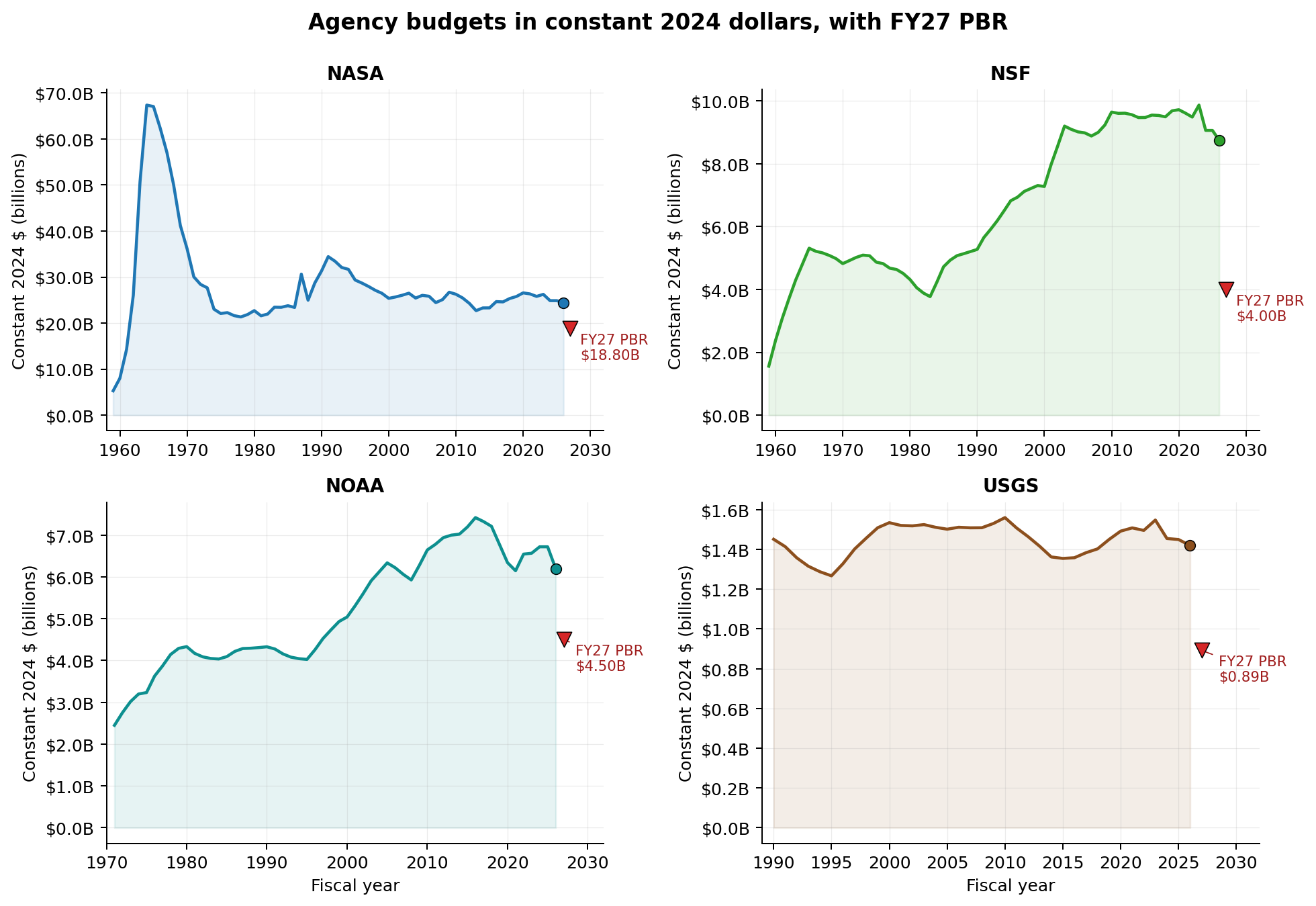
The simplest test is to look at these budgets across time. The cuts could be justified if today’s agencies were bloated relative to history. However, adjusting for inflation alone shows that the PBR is proposing the lowest budget for NASA since 1962, for NSF since 1983, for USGS since at least 1990, and for NOAA since 1996.
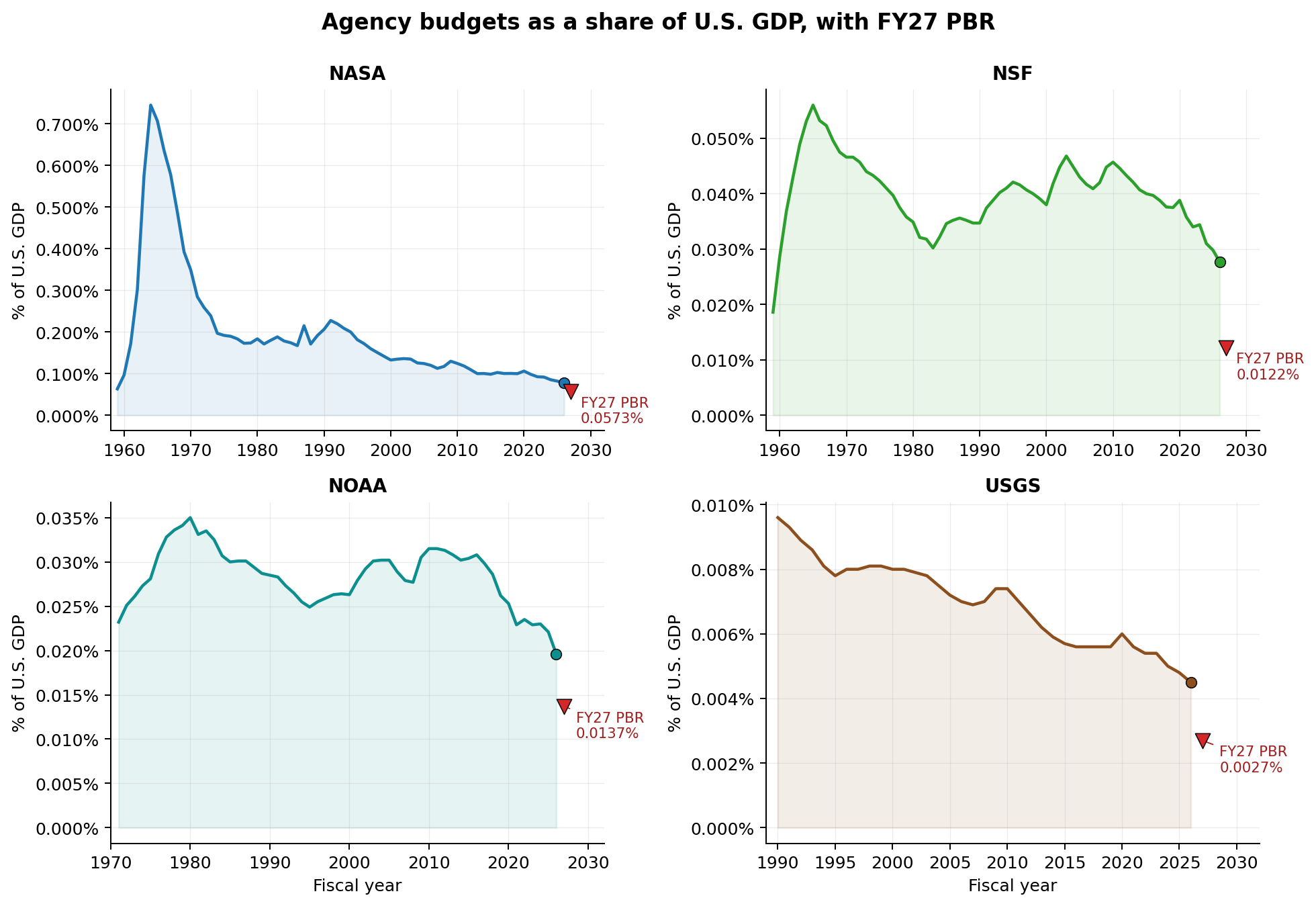
But is inflation-adjusted spending the right metric? Our GDP has increased by more than a factor of 2 since 1990, and our population has increased by about 40%. One would expect that as our economy and our population grow, that we would spend more on science. So here is the comparison corrected for inflation and then scaled by GDP: by this measure, last year’s spending was already at historic lows (with declines across most agencies since 2010), and the President’s PBR would just make that comparison more drastic.
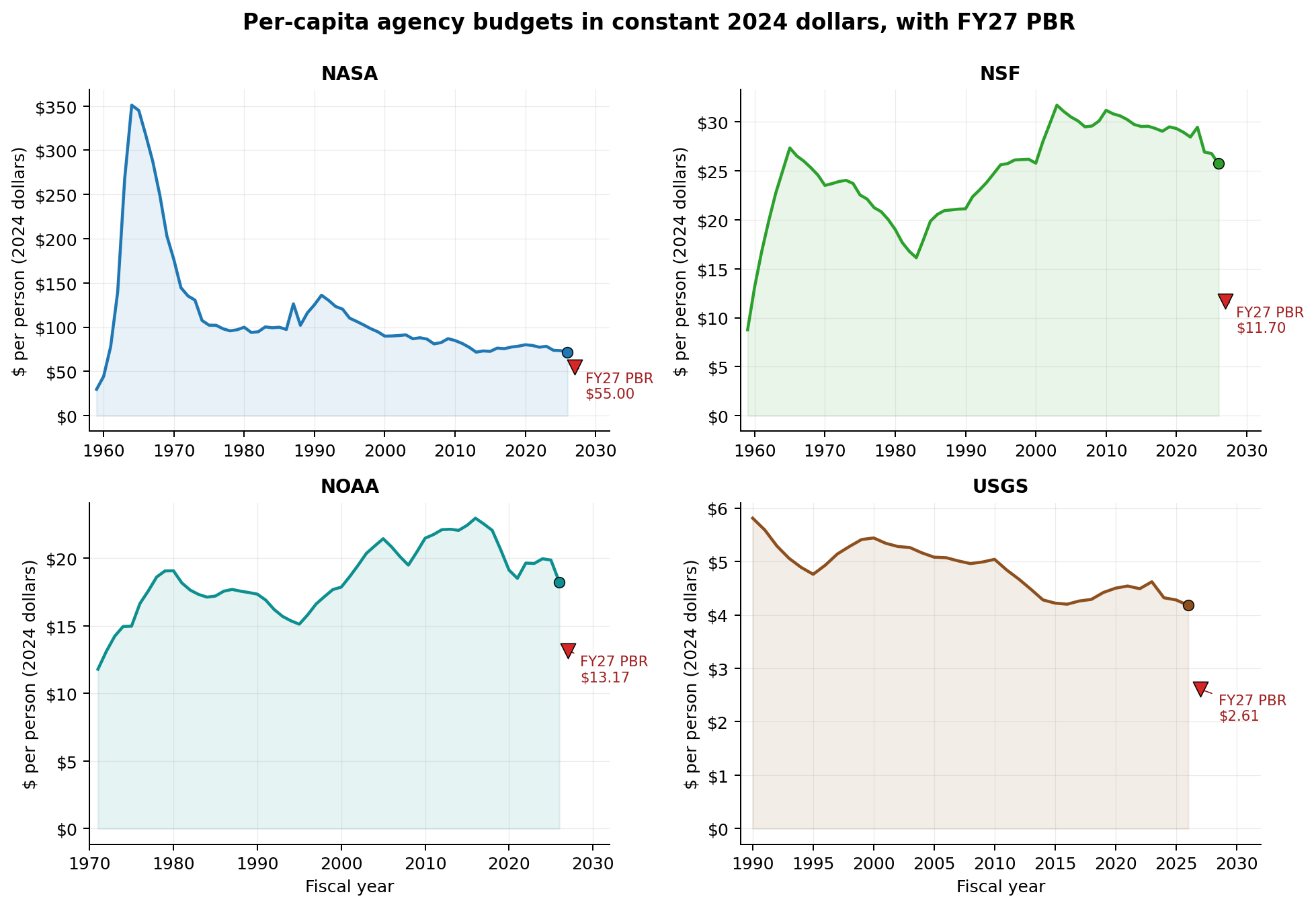
One could also do a per-capita comparison: this is how much each of us spend on supporting these scientific agencies (on average). Last year’s spending per capita for all 4 agencies combined was $120/year, and the PBR drops that to $83/year. Which is less than the cost of a full tank of gas for a typical SUV.
Other comparisons could be to how much our government is spending on other activities: e.g., the Iran war has already cost $30 to $50 billion, or more than the PBR for all 4 agencies combined.1 I personally think any one of these science agencies would be a better investment, much less all four together.
Science has been one of the key drivers of America’s greatness over the past century. This Administration is crippling it, but Congress can still hold the line. Note that holding the line on the budget is only part of this. Whistleblowers have already documented the Administration implementing the rejected FY26 PBR rather than what Congress actually appropriated, and last Friday the entire National Science Board was fired without explanation - leaving NSF with no board, no director, and no deputy director, and (as one ousted board member put it) effectively turning the agency into a pass-through for whatever the White House decides to fund. So the other part of holding the line is making the Administration spend the money it has been allocated in the way that Congress has directed, as required by law, and ensuring that the institutions Congress created to oversee science aren’t dismantled while no one is looking.
So my ask here is to please call your representatives and ask them to support our country’s federal scientific enterprise. This is especially important if you are represented by Republicans or by a congressperson on the Senate or House Committees on Appropriations.
Resources for further reading
For readers who want to track agency appropriations as the FY26 / FY27 cycle plays out, the AIP Federal Science Budget Tracker is updated regularly and covers all the agencies discussed here. The AAAS Federal R&D Budget Dashboard is the canonical source for R&D-specific budget authority going back to 1976; R&D budgets tell a similar story to the agency totals in this post but at finer resolution.
Analysis details
I used Claude to collect data, create figures, and review and format text. However, all text is originally drafted by me (despite Claude “volunteering” to write the whole post for me), and I try to sanity check all data and links.
Inflation adjustment is done using OMB’s chained price index.
Data comes from:
NASA: Wikipedia “Budget of NASA,” compiled from The Planetary Society. Full nominal and 2024-dollar series, FY1959–FY2026.
NSF: NSF.gov budget archive; CRS Reports R46753 (FY2021) and R48783 (FY2026).
NOAA: CRS Report R48157 (NOAA budget overview); USAFacts (FY1980–FY2024 net spending series); NOAA budget pages and Nature 2026.
USGS: CRS Reports IF12620, IF12097, IF13025 covering FY2023–FY2026 appropriations.
GDP: BEA NIPA tables / FRED GDP series.
Population: Census Bureau mid-year estimates (also from FRED).
FY27 PBR: Kozlov, Garisto & Chen, Nature 652, 547–548 (April 3, 2026, with April 9 NIH correction).
Footnotes
The estimate is based on a starting point of $25–35 billion that the Iran War had already cost by April 8th as estimated by AEI, plus $350 to $650 million/day since then (Penn Wharton Budget Model). This is likely conservative for direct costs. It also does not include indirect costs of higher gas and fertilizer prices due to the closing of the Strait of Hormuz, or the cost of care for injured veterans.