Environmental Injustice
The harm that hides in averages

Last week, the Hill reported that the Trump EPA was going to fire 22 more employees from regional Environmental Justice divisions. This is consistent with the general trend in the Trump administration to fire EPA staff and scientists across the government, and to attack anything that might help disadvantaged groups.
This will be a piece about Environmental Justice (EJ), but also about systemic problems and how we think about them. So, before we get into questions of EJ, I want to address some bigger philosophy issues. Namely, what influences a person’s lifepath? I’d argue you can break it down into genetics, environment, and the nebulous “free will.” Environment encompasses everything from in utero exposures and maternal effects to nutrition availability in childhood to school quality to air quality to family connections to, yes, racism. The challenge is that this is hard to see from a ground-level view: there are always examples of rags-to-riches successes (the American dream!), you can’t attribute a single case of assault to elevated lead levels, and successful individuals can see a pattern in their own lives that hard work pays off (an example of the survivorship bias fallacy). In fact, it is often taken as an insult when a suggestion is made that, as Obama said, “You didn’t build that [by yourself].” It is only with a bird’s eye view (and the help of statistics) that these patterns become clear. And this statistical approach will be the particular lens that I take on the EJ issue (though there are many others).1
What is Environmental Justice? We can look at the 2021 snapshot of the EPA webpage which defines it as:
“the fair treatment and meaningful involvement of all people regardless of race, color, national origin, or income with respect to the development, implementation and enforcement of environmental laws, regulations and policies”
I would think this statement would be uncontroversial, but the Trump administration does not see it that way.
Where can we see environmental injustice? A lot has to do with where people live. And where people live has a lot to do with the history of racism in this country (see The Color of Law by Richard Rothstein). But it also has to do with wealth and income. And race and poverty are all related to political power. And then where people live has implications regarding their exposures to air pollution, high temperatures, lead, and other environmental toxins.
A 2022 paper by Haley Lane et al. analyzed how historically redlined districts correspond closely to the districts with the most pollution (see Figure 1). According to the paper, these neighborhoods are still disproportionately composed of minorities and low-income families.2 The NCA53 included an analysis of how the Latino population in Houston is disproportionately clustered in the region with high NO2, high temperature, and high cancer rates (Figure 2). These disparities also hold true for temperature and income and childhood lead exposure and race (1, 2, 3).
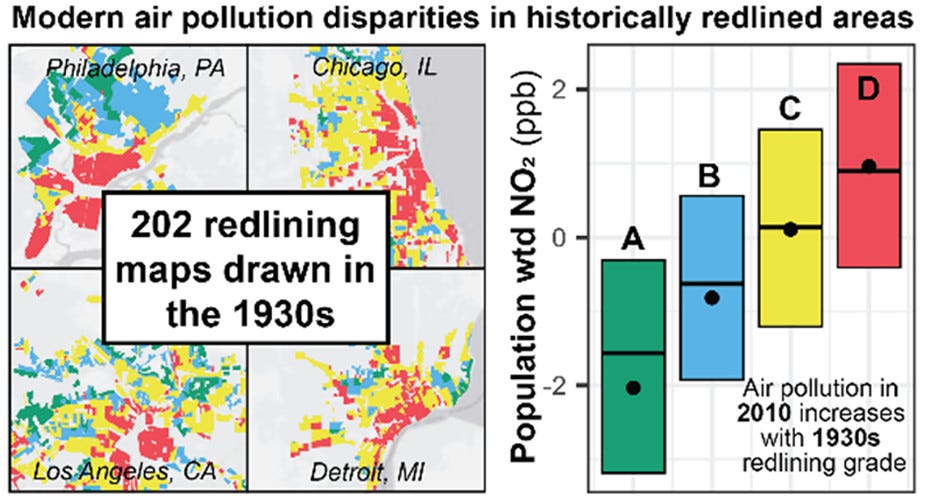
Figure 1: Modern air pollution correlation with historical redlined areas - Lane et al. 2022
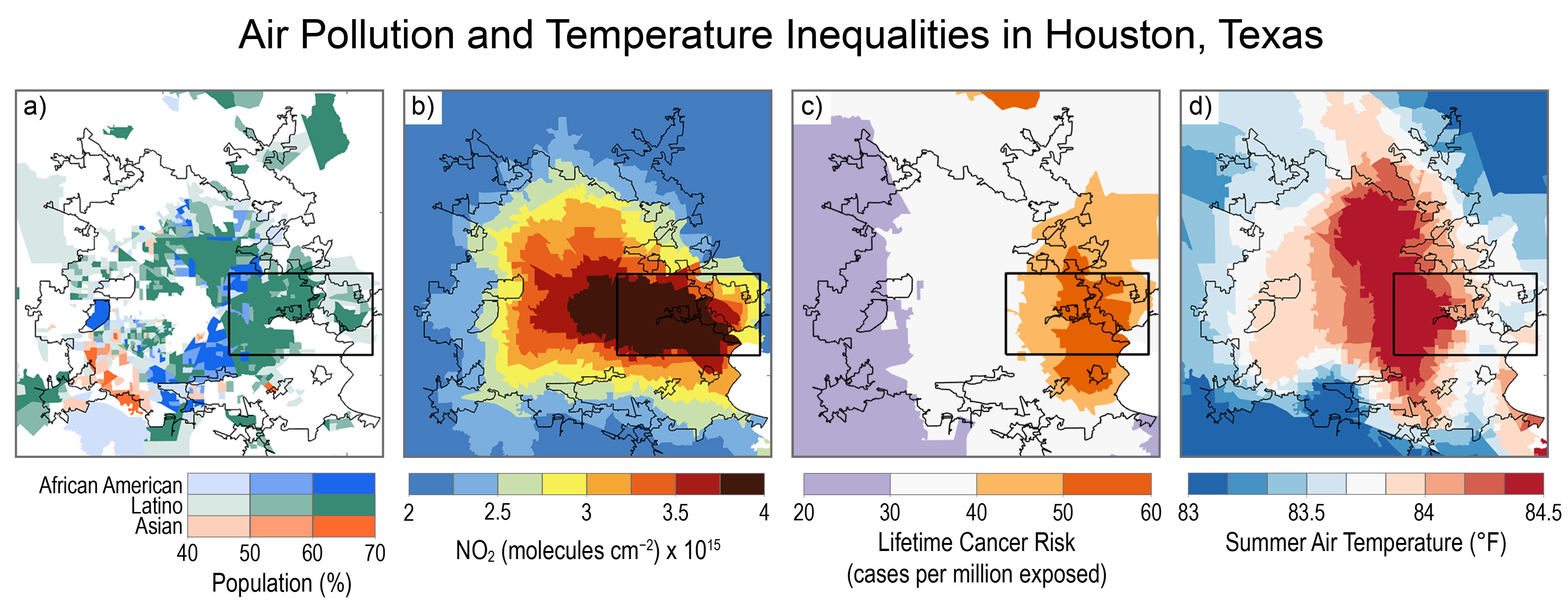
Figure 2: Latino population correlation with pollution, cancer risk, and temperature - NCA5
The fossil fuel industry is a large source of these unjust impacts. Extraction activities are disproportionately sited near indigenous and Latino communities. Exhaust from fossil fuel vehicles hits Asian and Black people the hardest.
There are all sorts of horrible impacts of these exposures: cancer, asthma, pre-term birth, and so forth. But I’d like to also highlight the relationship between a lot of these exposures and education and crime. It is well known that temperature impacts learning and test scores - and not only are children of color and low-income children living in the hottest neighborhoods, but they are likely to also have the worst access to air conditioning. Meanwhile, there is a strong link between even low levels of lead and learning, crime, and disorderly behavior.4 Again, there is a tension between recognizing that people have responsibility for their own decisions and also recognizing that people’s decisions can be influenced by environmental factors. Both can be true. And like a small increment of sea level rise can’t be shown to matter in any individual location but does matter when applied to thousands of miles of coastline, a small exposure to lead can’t be shown to matter for any given individual, but does matter on a population basis. And these effects on behavior and learning just make it that extra bit harder for people from these neighborhoods to succeed, before they even encounter any of the other barriers that society puts in the way of people of color and low-income individuals.
Nor is redlining just a historical artifact: there is evidence that racism still plays a role in housing markets to this day. Moreover, it isn’t just that these neighborhoods are worse because they’ve always been worse: more chemical plants are being placed in these neighborhoods precisely because they don’t have the political influence to say “no.” A recent Louisiana lawsuit at least gives a chance to these residents of “cancer alley” (a name well earned) to make their case to a jury of their peers.
So what can we do to address this problem? Well, the Biden Administration included funding in the Inflation Reduction Act to create the Community Change Grants Program, administered by the EPA. This program allocated funds to “communities most adversely and disproportionately impacted by climate change, legacy pollution, and historical disinvestments,” including tribes, territories, unincorporated counties, and communities suffering from cross-border pollution from Mexico. RFF wrote a great article on these grants, noting their cost effectiveness and citing a US Chamber of Commerce and Allstate estimate5 that for natural disaster and community emergency shelter grants, every dollar invested averts on average 13 dollars of future spending. This sounds great, right? So of course the Trump administration canceled these grants, possibly illegally. The Office of the Inspector General reviewed the grant process and gave the program a clean bill of health.6
I spent seventeen years at EPA trying, in my small way, to reduce harms that are real but hard to see from any one person’s vantage point. The EJ staff who were just fired were doing the same thing. The communities they were serving don’t have the luxury of debating whether systemic harm is real. They’re living in it. Our country built these patterns deliberately. We shouldn’t be dismantling these programs; we should be doubling down on them.
Nota bene: while I know the Endangerment Finding inside and out, EJ is not my area of primary expertise, and there are nuances I don’t fully grasp.
“For example, in 64% of grade D neighborhoods, a majority (>50%) of the population is POC (i.e., not non-Hispanic White); in 74% of grade D neighborhoods, the median income is low to moderate.”
It continues to be tragic that the Trump Administration took down the NCA, among many other scientific resources.
Talayero et al. 2023 state that “exposure to low levels of lead in childhood predicts a lower intelligence quotient score, conduct disorder, lower scores on tests of cognition, and poor neuromuscular development.”
Organizations not known for being “woke.”
My experience is that the OIG is great at making mountains out of molehills, so a clean bill of health is a high bar. Despite my own disgruntlement with the IG office, I think that they are an important watchdog, and the Trump administration’s dismissal of many IGs is yet another symptom of corruption.
Good post, Marcus.
You and/or some of your readers might be unaware that the Fifth National Climate Assessment (NCA5) website has been cloned here:
https://nca5.climate.us/