Reconsidering Reality
The Shoddy Case Against the Endangerment Finding

On August 1st, 2025, the Trump EPA released its proposal to reconsider the 2009 Endangerment Finding. The proposal offers several rationales: that the Clean Air Act does not encompass global pollutants; that in 2009 the EPA “unreasonably analyzed the scientific record“ and that developments since the Finding cast doubt on the 2009 conclusions; and that addressing GHG emissions through vehicle regulations would cause greater harms than benefits.
The Trump EPA was grievously wrong on all counts.
Several organizations submitted excellent analyses during the comment period. These include a masterclass from the Institute for Policy Integrity and a thorough summary from the Harvard Environmental & Energy Law Program. This post draws on their work, along with my own seventeen years of experience at EPA working on climate policy, to explain why the Trump EPA’s proposal cannot withstand scrutiny on the law, the science, or the engineering of regulation.
This post is also accompanied by a more in-depth supplement with full quotations from the text.[1]
THE LAW
Vinny Gambini: “Everything that guy just said is bullshit… Thank you.”[2]
The Trump EPA’s proposal includes a bizarro-world reading of Massachusetts v. EPA (2007), a new theory of the Clean Air Act invented from thin air, misinterpretation of recent Supreme Court decisions, complete disregard of the 2012 D.C. Circuit decision upholding the Endangerment Finding, and apparent ignorance of the existence of the 2016 Aircraft Endangerment Finding.
The proposal’s central legal claim is that the Clean Air Act only covers pollutants with “local or regional” effects - that GHGs don’t count because climate change is global. But this argument was already made and rejected. The Supreme Court in Massachusetts v. EPA explicitly addressed whether the “widespread harm” of greenhouse gases presented a jurisdictional obstacle. The Court said no: “EPA maintains that because greenhouse gas emissions inflict widespread harm, the doctrine of standing presents an insuperable jurisdictional obstacle. We do not agree.” (emphasis added) Note also that the 2009 Finding focused on the harms within the U.S.
Naomi Oreskes documented substantial evidence that lawmakers were well aware of climate when writing the Clean Air Act. Given that the Clean Air Act specifically includes effects on “weather, visibility, and climate” in its definition of welfare it is especially hard to argue that Congress did not consider climate impacts as a potential harm.
The Trump EPA claims the elimination of Chevron deference in Loper Bright (2024) changes things. But the EPA was not relying on Chevron. If anything, Loper Bright makes the Endangerment Finding stronger: given Mass v. EPA, less deference to agencies means the Trump EPA cannot simply reread the statute in novel ways to avoid a regulatory finding that was strongly suggested (even if not technically mandated) by the Supreme Court. The Loper Bright decision cuts both ways. Agencies can’t use statutory silence to avoid regulatory action either. A proper reading of UARG (2014) also invalidates the Trump EPA’s claims that the major questions doctrine is relevant, since UARG specifically calls greenhouse-gas standards a “modest step.”
The proposal also ignores inconvenient precedent. It never mentions the 2012 D.C. Circuit decision that upheld the Endangerment Finding against legal challenge, which stated that “EPA’s interpretation of the governing CAA provisions is unambiguously correct.”
And it ignores the 2016 Aircraft Endangerment Finding, which subjected these same scientific and legal issues to public comment again - contradicting the Trump EPA’s claim that these issues have never been publicly examined since 2009. The proposal also brings up the argument that the 2009 Finding was never submitted to the SAB. This was an argument that was dismissed by the D.C. Circuit, but the argument is also made moot by the fact that the 2016 Endangerment Finding was in fact submitted to the SAB.[3]
THE SCIENCE
John Polanyi: “Nothing is more irredeemably irrelevant than bad science.”
The Trump EPA claims the projections in the 2009 Endangerment Finding were “unduly pessimistic” and that “developments since 2009 have cast significant doubt” on its conclusions. This is demonstrably false. As I showed in “Did EPA Get the Climate Science Right in 2009,” observations in the 15 intervening years have fallen on or above the average projections of surface temperature, sea level rise, and CO₂ concentrations from the 2009 Technical Support Document, and most other indicators of climate change (glacial melt, sea ice retreat, ocean heat content, wildfires, and many others) have been consistent with or worse than the consensus projections at the time.[4]
For its scientific arguments, the proposal relies heavily on the Department of Energy’s Climate Working Group (CWG) report. A federal court has already ruled against DOE on FACA grounds. Climate scientists have thoroughly rebutted the CWG’s claims.
The contrast in scientific process is stark. I previously summarized the approach taken in 2009, which involved relying on the assessments which are the most rigorous and well-reviewed climate syntheses available. EPA’s TSD, which was just a summary of those assessments, underwent review by twelve named federal climate experts and public comment. Note that EPA was criticized because ONE of its expert reviewers was an EPA employee. In contrast, the DOE report was written in a rushed process by five cherry-picked authors. The eight unnamed reviewers of the CWG report were ALL DOE employees (and many of the reviewer critiques were ignored).
The Administrator also claims to have “considered critiques of the NCAs, and the Fifth NCA in particular” and “[r]ecently, several public watchdog organizations have raised concerns related to the process and quality of the Fifth NCA,” but oddly, never actually cites these critiques.
Within the proposal, Trump’s EPA makes several additional erroneous science arguments. The first is that scientists have not found that there is “greater capacity for the climate to reuptake GHGs in the atmosphere through natural processes” – while our understanding of carbon uptake by land and ocean processes has improved over time, there has been no substantial shift in our estimates of its net effect.
The second is that “[c]ontrary to the Endangerment Finding’s assumptions, data continue to suggest that mortality risk from cold temperatures remains by far the greater threat to public health.” The proposal cites Gasparrini et al. 2015 to support this contention – and in fact, the Gasparrini et al. analysis does estimate that cold deaths globally outnumber heat deaths. But the follow-up study Gasparrini et al 2017 also shows that generally, projected increases in heat deaths outweigh decreases in cold deaths due to warming. This counterintuitive pairing is a result of the high slope of the heat mortality curve (every added degree adds many deaths) compared to the shallow slope of the cold mortality curve (every degree change only has a small impacts). Work I co-authored (Lay et al. 2021) also found this net increase in deaths with warming.
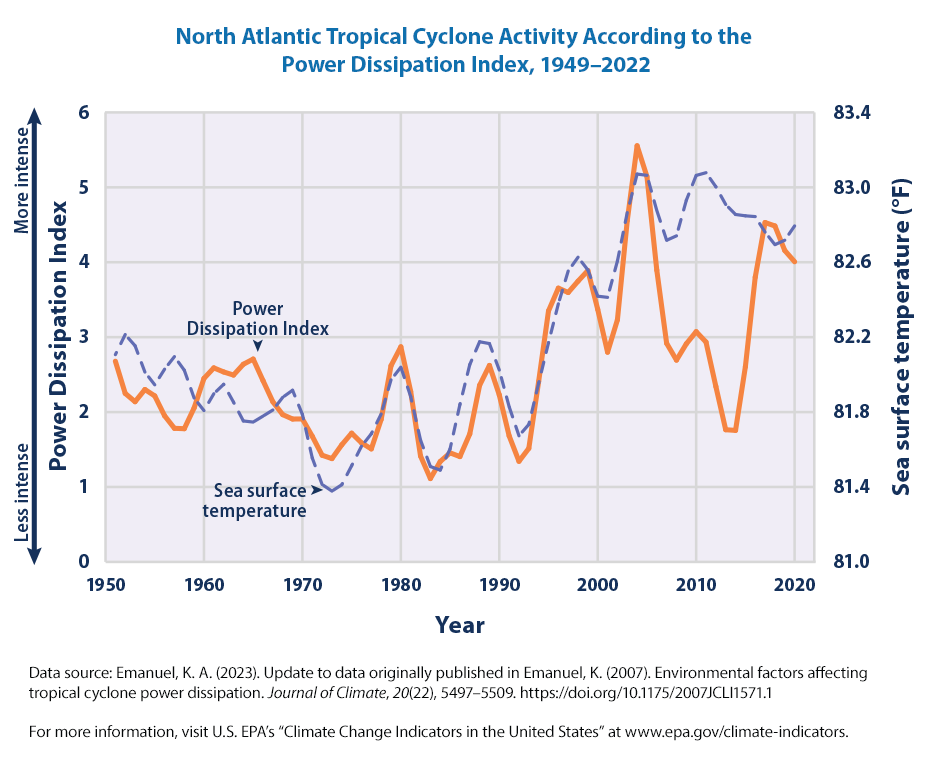
The third is claims that hurricanes, flooding, and wildfires have not demonstrably increased. While hurricanes are a challenging subject because of a short satellite record and substantial variability, state of the art projections still project increases in the most severe hurricanes.[5] Moreover, we expect more rainfall from any given hurricane due to warmer air, and more storm surge damage due to higher sea levels, among other changes. Flooding is also complicated because it is an interaction between rainfall and human-modified surfaces, but intense rain events have definitely increased [6]. Finally, US wildfires have definitely increased.[7]

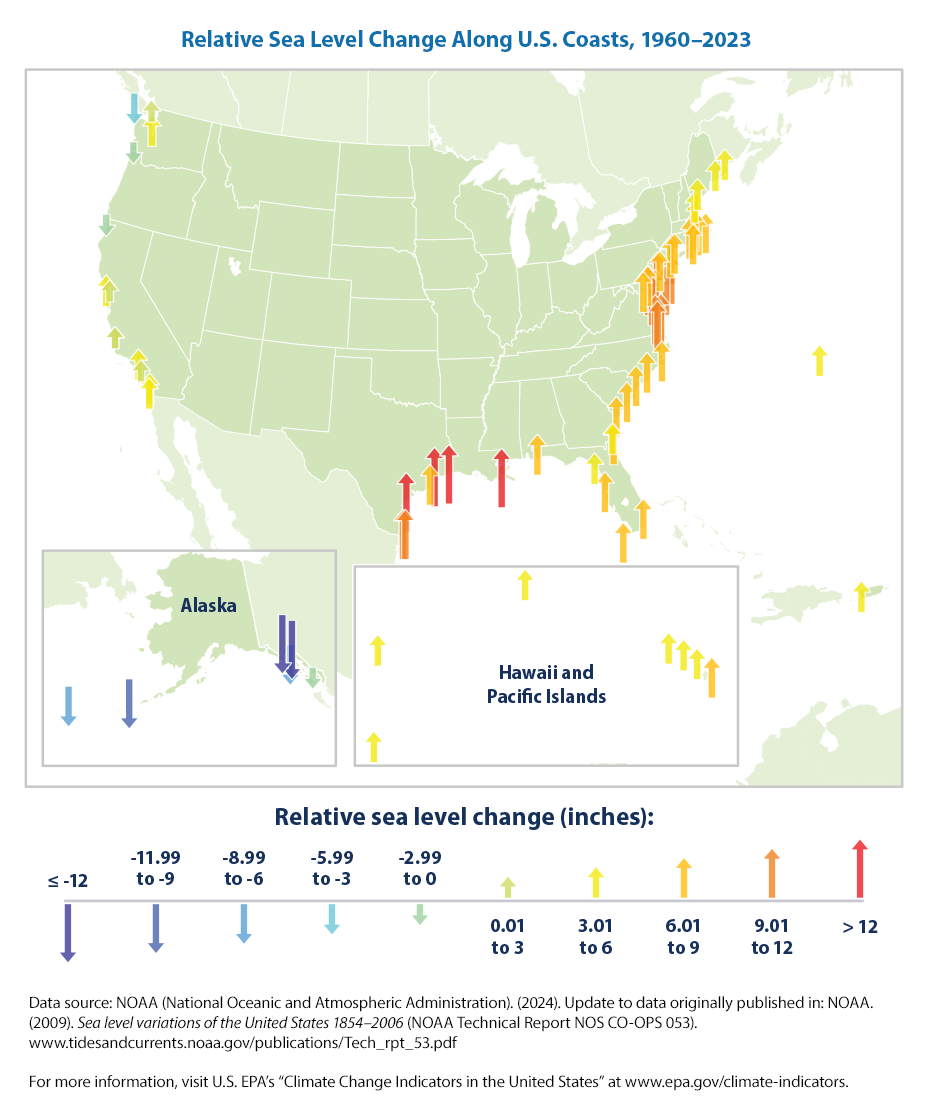
The fourth is a claim about sea level, where the Trump EPA disingenuously notes that “sea level has risen in some domestic localities while falling in others.” Yes, sea level in the US is falling on the south coast of Alaska and a couple of tide gauges in the Pacific Northwest as a well known result of post-glacial uplift. It is rising at an accelerating rate everywhere else, despite some bad analysis otherwise.
The Trump EPA also makes a bizarre argument about PFCs and SF₆, claiming that treating them together with other GHGs was improper because they have “many times the global warming potential of CO₂.” This reveals a fundamental misunderstanding of climate science. Yes, these gases have high global warming potentials per molecule - but their emissions are orders of magnitude smaller than CO₂, so their contribution to total warming is correspondingly small. This is a basic misunderstanding of atmospheric science.
The Trump EPA goes on to argue that the six GHGs shouldn’t be considered as a group due to differences in their chemical properties and emission profiles. However, VOCs are considered as a group. Particulate matter is considered as a group. Nor have there been objections to considering HFCs as a group. The EPA has historically classed pollutants in groups because they have similar relevant properties. As clearly stated in the 2009 Finding, the GHGs are grouped together because of similar properties (radiative, lifetime, etc.).
So, even ignoring the existence of the DOE CWG report, the little science that was explicitly included in the Trump EPA proposal was all irredeemably bad.
THE ENGINEERING OF REGULATION
State Farm: “That’s not how this works”
The Trump EPA argues that the 2009 Finding improperly “severed” the endangerment analysis from consideration of costs and regulatory effectiveness. The proposal claims EPA might have arrived at a different inclusion had it considered mitigation and endangerment together.
But Mass v. EPA was explicit: the endangerment finding must rest on “scientific judgment,” while “policy concerns” including costs come at the regulatory stage. The Court specifically rejected EPA’s “laundry list” of policy reasons for declining to act, holding they had “nothing to do with whether greenhouse gas emissions contribute to climate change.”
The D.C. Circuit confirmed this two-step approach in 2012: “At bottom, § 202(a)(1) requires EPA to answer only two questions: whether particular “air pollution”—here, greenhouse gases—“may reasonably be anticipated to endanger public health or welfare,” and whether motor-vehicle emissions “cause, or contribute to” that endangerment.”
The proposal’s claim that EPA “never meaningfully considered or invited public comment on the cost, effectiveness, and continued propriety of its GHG regulatory program” is simply false. Every EPA regulation undergoes notice and comment, with costs and benefits evaluated in regulatory impact assessments.
The Trump EPA also criticized the 2009 Finding for excluding adaptation and mitigation. Note that adaptive measures are generally not considered in making endangerment determinations – finding endangerment for air toxics does not, and should not, consider the possibility of purchasing gas masks as an adaptive measure.
The severance argument therefore fails both basic logic and fifteen years of rulemaking practice.
DE MINIMIS
Mass v EPA: “Agencies, like legislatures, do not generally resolve massive problems in one fell regulatory swoop”
The Trump EPA argues that U.S. vehicle emissions are too small a fraction of global emissions to matter—that even eliminating them entirely “would not have a scientifically measurable impact” on climate change.
The Supreme Court rejected this exact argument in Mass v. EPA: “Agencies, like legislatures, do not generally resolve massive problems in one fell regulatory swoop… And reducing domestic automobile emissions is hardly tentative. Leaving aside the other greenhouse gases, the record indicates that the U.S. transportation sector emits an enormous quantity of carbon dioxide into the atmosphere.”
Additionally consider this analogy for scientific measurability: you might not know the precise height of a mountain, but you know that if you build a house on top of it, the mountain is now taller. Uncertainty about total warming doesn’t change the fact that adding emissions makes it worse and reducing emissions makes it better.
CONCLUSION
The Trump EPA has now received the comments submitted by IPI, Harvard, and hundreds of others. It’s hard to see how any of its arguments can survive a legitimate consideration of the criticisms from these organizations. But the Trump EPA cannot just make up new arguments: the final rule must constitute a “logical outgrowth” from the proposal.
What to watch for: I would assume that there will be no references to the CWG left in the final regulation after its critiques by the scientists and its loss in the court. If the Trump EPA keeps it in, that would be a major vulnerability. More uncertain is the other bad science from the proposal – do the proposal authors even know that it is bad science? Which of the legal arguments will remain, and will the agency try to slip in new ones despite the “logical outgrowth” limitation? We may see very soon.
In any functioning legal system, this regulation would be laughed out of court. The D.C. Circuit upheld the original Finding in 2012; the legal and scientific arguments have only gotten stronger since. But the Supreme Court has shown itself willing to abandon precedent and strain statutory interpretation to achieve policy outcomes. If this proposal is finalized and survives only because the Supreme Court chooses to overturn Mass v. EPA, that will be yet another reason for Court reform in a future administration.
For now, the record is clear. Trump EPA’s arguments fail on the law, the science, and basic logic. The Endangerment Finding was right in 2009. The science has only gotten stronger. And no amount of motivated reasoning can change atmospheric physics.
[1] I’m still experimenting with how to write clear Substack posts. My draft was becoming unwieldy with massive quotes, and splitting them out into a separate document seemed like the best way to keep this article readable but still be thorough. Also, thank you to C.N. for suggesting that I join the 21st century and use hyperlinks rather than footnoted URLs.
[2] If you haven’t seen My Cousin Vinny, go watch it now. This post will wait.
[3] A copy of the Science Advisory Board’s letter to EPA that memorializes its decision not to undertake such a review can be found in the docket for the 2016 Findings under Section 231(a)(2)(A): EPA–HQ–OAR–2014–0828. This is in contrast to how the SAB has reviewed Trump EPA actions. Under this Administration, the SAB has been vacant for over a year and the Trump EPA appears to be trying to stack a revised panel with chemical lobbyists.
[4] Again, the reliance on consensus is important: contrarians often cherry pick statements from individual scientists like a projection that Arctic sea ice would collapse by 2016 (https://www.theguardian.com/environment/2012/sep/17/arctic-collapse-sea-ice). This was not anywhere close to a consensus finding among scientists – rather, it was an extreme outlier.
[5] A study I co-authored (Guikema et al. 2025) found that while five out of seven models considered projected a decrease in landfalling tropical storms, all seven models projected an increase in the number of landfalling category 5 hurricanes. This is generally consistent with the findings of the broader literature: warmer oceans can support stronger storms, but changes in winds and African dust might actually decrease storm frequency.
[6] See Figure 2.8 in NCA5. Again, it is tragic that the US government no longer hosts the NCA. While climate.us has done a masterful job of resurrecting the NCA, I was unable to figure out how to directly link to a single figure in the new version.
[7] Similarly, it is tragic that the EPA Indicators are no longer hosted by the US government and I have to link to the January snapshot instead.