The Optimism Shelf
Three climate books worth reading

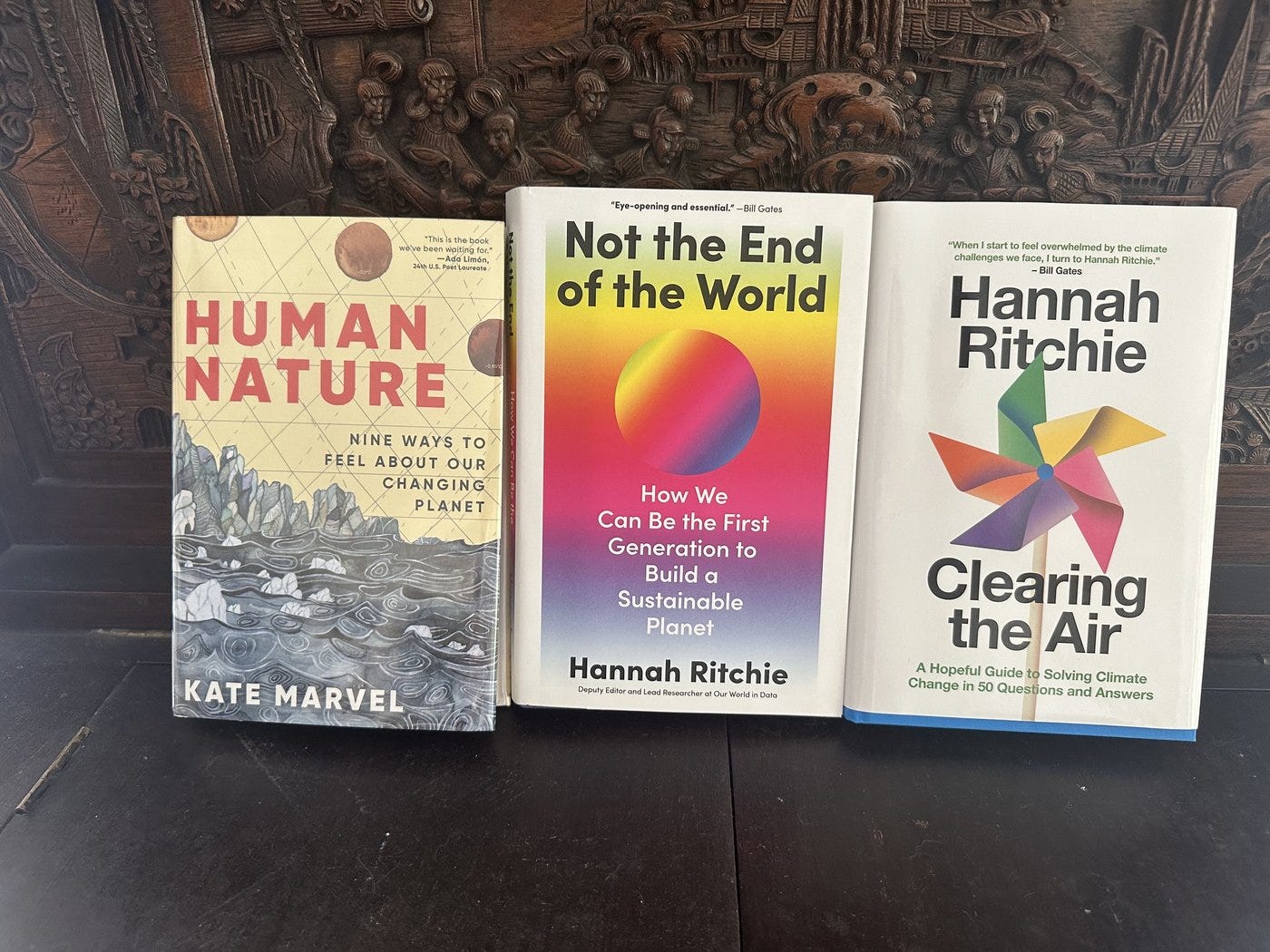
95% of what I read is science fiction and fantasy, and I will make book recommendations for those genres someday. But today’s post is about three climate books I’ve read in the past year.1
Hannah Ritchie wrote Two Great Books
I’m a fan of Our World in Data, and so when I saw that Hannah Ritchie of that organization (now Deputy Editor and Science Outreach Lead, formerly Head of Research) had written a book about the environment called Not the End of the World: How We Can Be the First Generation to Build a Sustainable Planet I was intrigued. TL;DR — I highly recommend both that book and her subsequent book, Clearing the Air: A Hopeful Guide to Solving Climate Change in 50 Questions and Answers.
The overall theme of Not the End of the World is sustainability: how can we reach the point where we leave the environment in better shape than we found it, while still meeting the needs of those currently alive? Hannah then dives into seven specific environmental problems to look at what the data tells us about where we came from, where we are, and where we are going. Those seven environmental problems are:
Air Pollution: The Great Smog of London is the poster child of air quality events, likely killing more than 10,000 people. But today, one can walk about London and breathe freely. There is still too much pollution, but even China has passed peak air pollutant emissions, so a clean air future is within our grasp.
Climate Change: I talk a lot about climate change in this substack. I believe that it is a problem, and that we aren’t doing enough to reduce GHG emissions. But remember in 2009 I was a coauthor on a paper that projected a median warming of 5.1 °C in 2100, and my analysis in 2024 showed a median warming of 2.9 °C — still too high, but a big move in the right direction. Hannah Ritchie points out that while total emissions are still increasing, CO2 emissions per capita appear to have peaked, which is another optimistic point (though again, we still have a long way to go).
Deforestation: Hannah looks at the trends in deforestation (again, dropping, but still too high), and the primary causes of deforestation (beef is number one by a large margin, then oil seeds number two2).
Food: Thanks to the Haber-Bosch process and the Green Revolution, we already produce more than enough food to feed the world, but too much goes to cows and cars and waste. We have already passed “peak agricultural land”, and if we reduce meat consumption and continue to intensify agricultural production, we could use even less. Moreover, we might be reaching peak fertilizer as well.3
Biodiversity Loss: We have been eliminating animal species for about 50,000 years (goodbye to giant kangaroos, ground sloths, or mastodons). Agriculture and habitat destruction, pesticides and other chemical pollutants, and climate change have all added additional pressures. But… some charismatic species that were endangered have recovered due to targeted policies. Non-charismatic species like freshwater insects have also recovered due to clean water policies. So again, things are bad but we are moving in the right direction and with additional work, we can reduce extinction rates to normal levels (of course, the Trump administration is going backwards on wildlife protection and protecting desert landscapes, all while lying about it).
Ocean Plastics: Hannah discusses the benefits of plastics, the fact that a majority of plastic waste comes from packaging and developing nations, and limits of recycling. Interestingly, she finds that the solution to plastic waste is less ‘reduce, re-use, recycle’ and more ‘build better landfills and waste management systems.’ Also, fining marine vessels for losing ropes, nets, and lines in the ocean, and participating in beach cleanups.
Overfishing: We were killing 80,000 whales a year in the 1960s — that number has dropped to less than 2,000 a year. On the other hand, about a third of global fish stocks are being overexploited. The EU and North America have made progress towards sustainable fishing, but still have a ways to go, and other regions are further behind, and again, the Trump administration has moved backwards on marine protected areas. Unfortunately, there is less optimism for corals due to pressures from climate change (warming and acidification), pollution, and fishing and tourism damage, though there are a couple of bright spots in terms of refugia and adaptation.
There are a lot of win-wins here: reducing agricultural land can reduce deforestation, thereby reducing both CO2 emissions and biodiversity loss. Moving away from fossil fuels helps with both climate change and air pollution.
There are many things I like about this book. 1) It starts with the data, and in areas where I have expertise, it matches my understanding. 2) It addresses some common misperceptions. 3) It is well written and readable. 4) It is both optimistic and realistic: many trends are in the right direction and we have the tools to reach sustainability, but the book doesn’t minimize the problems we face or the challenges we still have to overcome.
Clearing the Air: A Hopeful Guide to Solving Climate Change in 50 Questions and Answers
The list of “what I like about this book” for Not the End of the World applies equally well to this book. Instead of summarizing Clearing the Air in depth, I am going to highlight a few anecdotes from the book.
Hannah looks at a number of questions regarding the pros and cons of different sources of electricity. Just like I stated in my previous substack post, a lot of this question comes down to fossil fuels versus renewables. Hannah showcases two interesting and relevant statistics: deaths per unit energy produced, and human-related bird deaths, both of which show renewables trouncing fossil fuels. And a news update: since my substack post, Trump has allocated another 1.2 billion dollars to kill another offshore wind project.
In addition to tackling energy sources, Hannah also discusses energy usage. She highlights heat pumps as one efficiency solution. As Project Drawdown notes, heat pumps are even more awesome than you think. Hannah Ritchie identifies a common misconception that heat pumps won’t work in very cold climates, and points out that, contrary to that misconception, Norway, Finland, and Sweden have the highest penetration rates in Europe (40–70 units per 1,000 households in 2021, see figure in this Carbon Brief article). Of course, Trump has sabotaged a number of projects that would have funded heat pumps, like for an apartment building in Syracuse that didn’t have air conditioning and had an inefficient heating system.
My final anecdote from the book is this quote that addresses the de minimis argument: “The ‘too small to make a difference’ argument taken to the extreme means that no one — anywhere — should do anything to tackle climate change.” Hannah did follow up by saying, “This question is less relevant to American readers because the US is still a relatively big emitter.” But tell that to Lee Zeldin.
Human Nature by Kate Marvel
Kate Marvel is one of those amazing people who can both do cutting-edge science and communicate about it effectively. Human Nature: Nine Ways to Feel About Our Changing Planet is a masterpiece that is deeply personal, brilliantly written, and contains rock solid scientific explanations. She covers nine emotions in her book. I wouldn’t do justice to her words by summarizing them, so instead I’m going to present anecdotes from my own experiences inspired by each of the nine emotions that Kate covers, and encourage you to read the book itself to experience all of Kate’s marvelous prose (rereading it for this review, I laughed out loud again at her fake movie scripts in Chapter Six).
Wonder: The thing I love about science is the ability to understand the world around us. When I present on climate change, I sometimes show a map of the world, and point out the visible patterns of two strips of deserts at about 25 degrees north and south of the equator. This pattern can be explained by Hadley cells. As air warms at the equator, it rises. As it rises, it cools. Cooling condenses water vapor, creating rain and watering the equatorial jungles. But then, the air has to go somewhere, so it goes north and south. When it falls to the ground, it heats up.4 And because the liquid was already removed from the air, this warm air is very, very dry… thus, deserts! So, I wonder at the science of the world, but I also wonder at our ability to comprehend it: we’ve built climate models where, by simply putting in the geography of the continents and the physics of how the atmosphere responds to a rotating Earth (the Coriolis effect), we can recreate Hadley cells, the Gulf Stream, and all these other aspects of our world — all from first principles!
Anger: Oh, yes, I have anger. My anger is most focused at the people who know better, but lie because it serves their purposes, and the world suffers for it.
Guilt: Plane trips are my biggest source of unnecessary carbon. I don’t own a car, I eat vegetable-forward, I live in a modest apartment, we try to use heat and air conditioning modestly, and my primary hobbies are reading, walking, and contra dancing, none of which are energy intensive. But… I love snorkeling in coral reefs, I went to Alaska to see the glaciers, and I travel for weddings. But I do believe that the way forward for humanity is not individual actions of deprivation (though it is never bad to avoid conspicuous consumption and needless waste), but rather to try for systemic societal changes.
Fear: Seeing Canadian wildfire smoke in the air above DC highlighted the doomsday aspects of climate change this summer. Climate change may not threaten human existence, but it will lead to many negative consequences, and I fear the consequences we don’t foresee even more than the ones we do understand.
Grief: I mourn the corals and the glaciers.
Surprise: Don’t throw me a surprise party: I prefer to know about it and prepare appropriately. But on the other hand, I love being pleasantly surprised by a delicious new dish, a movie that was way better than expected,5 or a gorgeous rainbow. Whereas I did not like one bit the surprise of a storm drain flooding my sixth-floor apartment. May we have more good climate surprises (like the astounding advances in renewable and battery technology in the past decade) and fewer bad ones.
Pride: Watching Pathfinder land on Mars. The development of mRNA vaccines for COVID in record time. Hundreds of millions of dollars raised every year by GiveWell6 to use for effective help for the neediest people on the planet. These are things that make me proud of the human race.
Hope: Humans have done amazing things (see Pride). We are facing many terrible problems, often of our own making, but many of them ARE getting better (see the first book review in this post). I hope humans can overcome their worst impulses (cough Trump cough) and instead work together to hand the next generation a planet that is better than the one we received.
Love: I am grateful for the love I have received from the animals who I have spent time with over the past decade (in approximate order of when I met each of them) (apologies to the many deserving pets I haven’t included):

Top row, left to right: Louis Pasteur (2006–2024), Luna, Copper.
Bottom row, left to right: other Luna, Lola, Tsuki.
My next book reviews might be about the cli-fi books Termination Shock and The Ministry of the Future.
Hannah actually defends palm oil as being a particularly productive crop per acre of land, notes that the Roundtable on Sustainable Palm Oil (RSPO) certification can help identify palm oil that didn’t replace primary forest, and excoriates the use of palm oil for biodiesel as a particularly wasteful activity.
I have plans to try and link historical fertilizer and pesticide usage to temperature, thereby finding a climate linkage. It is one out of many potential research ideas I have… we’ll see if I get to it in the next year or not.
One of my professors at MIT got to see an early screening of Day After Tomorrow. At one point in the movie, one of the characters is talking about cold stratospheric air falling to the surface, and the other character asks, “but won’t it get warmed as it falls?” My professor nodded along at this point. Then the first character says, “no, it is falling too quickly!”, and my professor wanted to yell at the screen about adiabatic compression and how the faster it falls and compresses, the more it warms, not less! It is always fun to go to SF movies with people who really understand the science. Well, fun for me, anyway. Maybe not fun for the people around me?
Looking at you, Pirates of the Caribbean. Who knew a movie based on a Disney ride would be so good?
Hannah Ritchie also name dropped GiveWell as one of her go-to charities.
Marcus… you can add this to your list of optimistic events…
Global mean vegetation greening reached a record high last year, extending an already significant multi-decade upward trend, according to https://www.nature.com/articles/s43017-026-00776-0 published in Nature. In fact, 2025 set a record for global vegetation greening with a steepening of the average trend. Top of the list with 77.6% showing extra greening was croplands, meaning more food is becoming available to boost global diets.