
RCP8.5 (and its successor SSP5-8.5) was designed to be a high-end scenario for use with GCMs and ESMs. The highest of the newly released van Vuuren scenarios that will underpin CMIP7 is cooler than RCP8.5 in 2100. Gallons of e-ink have been spilled on just how implausible RCP8.5 actually is, whether it was used incorrectly, and what to do about it. In my opinion, a mountain has been made out of a molehill… but unfortunately, once that mountain exists it needs to be addressed so that no babies get thrown out with the bathwater (to mix some metaphors). This has some parallels with the GWP/metrics world, where an academically interesting question (how best to use a single metric to represent substances with very different atmospheric lifetime behavior) has become a political touchpoint (I’ll get back to this in a future post).
Today’s post is about the new proposal by the Trump Administration to “amend” the Fifth National Climate Assessment. This proposal is dumb, as I explain in my draft comment below. Comments are due by September 9th.
I have also submitted a new paper that addresses the use of RCP8.5 in damage function creation, among other topics. Relevant to today’s post, the paper demonstrates a valid use of RCP8.5. If it gets posted as a preprint, it will be the subject of a future post.
Comment on the Proposed Amendment to the Fifth National Climate Assessment (NCA5)
Subject Line: RFI Response: Proposed Amendment to NCA5
To whom it may concern,
I am writing to express my opposition to the proposed amendment (pdf) to the NCA5 assessment (91 FR 54893). The amendment is wrong on procedural grounds, unnecessary because the assessment already labels the scenarios properly, scientifically incomplete because it does not recognize that scenarios were used as forcing scenarios rather than emissions scenarios and therefore have a larger uncertain range due to carbon cycle and other climate system uncertainties, potentially over-reaching in that the amendment could forbid proper uses of high scenarios, and confused regarding the language that NCA5 used regarding the 8.5 scenario. I address these criticisms in turn:
1) Procedurally improper
National Climate Assessments are required by the Global Change Research Act of 1990 (GCRA). Every assessment produced under it has been developed through steering committees, named author teams, public comment, interagency review, and National Academies review. There is no established mechanism for post-hoc “amendments” to completed assessments. Even if there were, the NCA is a Highly Influential Scientific Assessment (HISA) and must meet Information Quality Act (IQA) standards for transparency, independence, expertise, and public documentation of review. This amendment does not meet any of these standards: no disclosed process (transparency), no identified reviewers (independence), no named authors (expertise), no peer review plan (public documentation of review).
This document does not credit any human author for its creation. Given that the document is hosted by NOAA, and NOAA Administrative Order 202-735D-2 on Scientific Integrity requires NOAA employees to “[a]cknowledge in publications the names and roles of those who made significant contributions to the research,” this is an important oversight.
Moreover, the claimed authority for the amendment is EO 14303 on “Restoring Gold Standard Science.” An Executive Order cannot overrule a congressionally mandated process. Meanwhile, EO 14303 enumerates nine characteristics of Gold Standard Science, including “transparent,” “communicative of error and uncertainty,” “skeptical of its findings and assumptions,” and “subject to unbiased peer review.” This amendment has no named human author, was not subject to review, ignores climate system uncertainty (see Point 3), and mischaracterizes the original NCA (see points 2 and 5). Therefore it fails at least four characteristics of the standard it claims to uphold.
If there are any concerns regarding material within NCA5, the best approach would be to prioritize development of a sixth National Climate Assessment, which, on the four-year timeline mandated by the GCRA, would be November of 2027, just 15 months away.
2) Unnecessary
NCA5 clearly labeled scenarios as “Very high” (8.5), “high” (7.0), “intermediate” (4.5), “low” (2.6), and “very low” (1.9) (Figure 1.4), and this language is used universally throughout the assessment. This language meets the requirement in the proposed amendment that RCP8.5 should not be categorized as “expected, likely, central, or business-as-usual conditions.” The scenario labels also line up well with recent probabilistic estimates, such as Sarofim et al. (2024) which found a median forcing scenario around 5.1, or slightly higher than the NCA5 “intermediate” scenario, where “intermediate” and “median” could be considered to be equivalent categorizations.
Other parts of the assessment use a “warming-level” or “by-degree” approach to displaying data — see Figures 2.9 and 2.10, showing changes at 1.5, 2, 3, and 4 degrees C, or Figure 19.1 (the chapter I coauthored) showing damages at 3 degrees F. Showing warming-levels removes time and scenario elements from the scientific implications of different temperatures. As an NCA author, I advocated (with success) to move away from scenario-based language and towards warming-level language for this reason.
The amendment language does not demonstrate that the already existing language and approach used within NCA5 is not already sufficient.
3) Scientifically incomplete
I will also note that the USGCRP determination has left out the key influence of climate system response uncertainty in radiative forcing projections. The document states that, “The scientific literature has increasingly concluded that achieving radiative forcing levels equivalent to RCP8.5 or SSP5-8.5 would require a combination of demographic, economic, technological, and energy-system developments that are inconsistent with current observations, mainstream projections, and present understanding of global energy markets. [2,4,5,6,7,8]”: the list of developments is entirely concentrated on the emissions side, and not on the climate system side, which is a key omission.
Sarofim et al. (2024) found that while exceeding 8.5 W/m² was only a 1 in 200 probability, it was 20 times more likely than exceeding the SSP5-8.5 emissions level. Inclusion of additional climate system feedbacks such as methane-derived ozone damage on ecosystem uptake or permafrost feedbacks could increase that probability even more. Note also that the Sarofim et al. (2024) estimates were produced before the current administration started prioritizing fossil fuels again. Should the administration succeed in revitalizing the fossil fuel industry, that would lead to increases in the projected radiative forcing in the future.
The amendment states that, “the Chapter 3 discussion should not be interpreted as implying that reversal of current renewable-energy or efficiency trends would, by itself, restore SSP5-8.5 as a plausible policy-relevant planning scenario.” However, if the amendment already underestimated the probability of 8.5 W/m² because it didn’t consider climate system uncertainty, then this reversal does become relevant. All of these elements together could mean that the probability of exceeding 8.5 W/m² could be several percent or more, which are policy relevant probabilities for impacts as broad reaching and transformative as we expect from climate change.
4) Over-reaching
Interpretation Guideline 4 states that “RCP8.5, SSP5-8.5, or equivalent pathways are not policy relevant, and should not be used in authoritative federal work products.” This is problematic for impact analyses that stretch to the 1% probability range, that use high scenarios for damage function creation, or that look at dates beyond 2100. NCA5 Box A3.1, Projecting Climate Impacts Beyond 100 Years Into the Future, stated that very high scenarios “can be useful tools when considering a range of plausible greenhouse gas concentrations past 2100.” Sarofim et al. (2024) found a 7% probability of exceeding 8.5 W/m² by 2150, which is just as likely as exceeding 7.0 W/m² by 2100 — the scenario that NCA5 labels “high” and which the amendment does not challenge. The van Vuuren et al. (2026) paper that the amendment calls “[t]he most current basis for this proposed amendment” extends emissions to 2500 and asks that ESMs run through at least 2150. The median effective radiative forcing of the high scenario is 8.57 W/m² in 2150 and still rising (see Figure 2 of the paper and the data archive at 10.5281/zenodo.20713982). The amendment relies on this paper while declaring implausible the median forcing level from one of that paper’s scenarios.
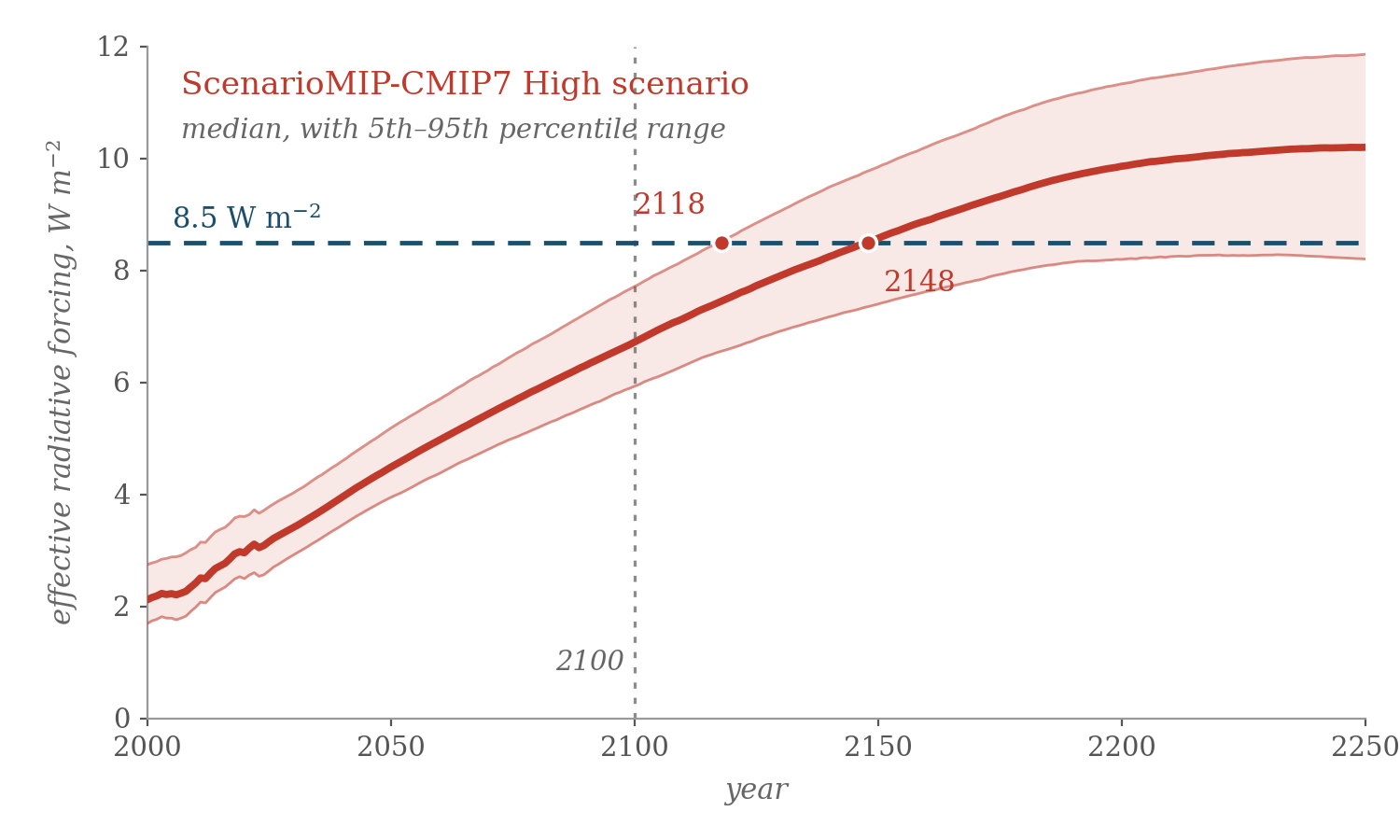
Figure 1. Total effective radiative forcing under the ScenarioMIP-CMIP7 High scenario: median, with the 5th–95th percentile range across the 841-member calibrated ensemble. The median crosses 8.5 W m⁻² in 2148; the 95th percentile crosses in 2118. Data from van Vuuren et al. (2026), Zenodo 10.5281/zenodo.20713982 v1.1.1.
Given that the Global Change Research Act of 1990 specifically directs the government to produce an assessment which “analyzes current trends in global change, both human-inducted [sic] and natural, and projects major trends for the subsequent 25 to 100 years,” and given that 100 years from the publication of NCA5 would be 2123 which is well past 2100, it is a major failure of the amendment not to consider 8.5 W/m² in the context of post-2100 timeframes. The van Vuuren High scenario’s 95th percentile exceeds 8.5 W/m² by 2118, before that 2123 timeframe.
5) Confusion regarding high and very high
The amendment states that, “That update is directly relevant to NCA5 because NCA5 defines the high emission scenario as RCP8.5. For [sic] CMIP5 and SSP5-8.5 for CMIP6,” and again, that “The NCA5 front matter and the Guide to the Report define the High Scenario as RCP8.5 in CMIP5 and SSP5-8.5 in CMIP6.” Actually, Table 3 in the NCA5 Guide to the Report defined the high emission scenario as 7.0. 8.5 was considered to be “very high.” It is certainly not a good look for this amendment that the authors have mischaracterized the NCA5 language on an issue that is central to the entire purpose of the amendment.
To conclude, I again express my opposition to this proposed amendment to NCA5. It is procedurally flawed, unnecessary, scientifically incomplete, over-reaching, and confused about the terminology at the center of its own premise.
Note that the views expressed in this comment are those of the author and not those of any of my affiliated institutions.
—Marcus C. Sarofim, PhD, EPA 2008–2026, NCA5 author
Comment Errata
My first draft used the phrase “procedurally bankrupt,” but despite its truth, I decided to soften it for government purposes. My first draft of many comment responses was often more fiery than the final draft that made it into government documents. As my bosses and colleagues often reminded me, the government should be dry, factual, and professional rather than snarky, regardless of how much the commenter deserves it. If only the current Administration could follow that philosophy.
Another issue that did not make the submission is that some people have run the document through Pangram and the result was that the document appears to be 100% AI generated. In addition, the meta-data of the pdf has “python-docx” as the author. It is not impossible that bureaucratese reads as AI, and that a human drafted an original and used AI to copyedit and AI generated a new updated file… but it is certainly suggestive that this administration is outsourcing to AI. Again. Though not as badly as the earlier health fiasco or the ongoing abstinence-only mess-up given that no hallucinated references have been identified as of yet.
Another data point I chose not to add is that when I add in the permafrost and methane-derived ozone ecosystem impacts to FaIR, the High van Vuuren scenario does have a roughly 0.2% chance of exceeding 8.5 W/m² even in 2100. The comment notes that the van Vuuren High scenario just barely exceeds 8.5 W/m² in 2150, but because of the inertia of the climate system, some rough calculations I did suggest that the van Vuuren High scenario in 2150 will likely be a couple tenths of a degree warmer than the SSP5-8.5 scenario in 2100, adding more weight to my assertions than I could carry with published material alone.
Also, redoing the RFF-SP calculations with the newer version of FaIR calibrate (1.6.0), I get a probability of exceeding 8.5 W/m² in 2100 of 1.6% and in 2150 of 11.4%, but if I add the methane derived ozone ecosystem impacts and permafrost feedbacks, those numbers rise to roughly 4% in 2100 and 20% in 2150. Again, I rely on the published numbers from Sarofim et al. 2024 as the version of record, even though the updated calculations would do a better job of supporting my point.
To Make a Long Story Short… Too Late
RCP8.5 is not a business-as-usual scenario. Its emissions are implausibly high, though its radiative forcing may be within the upper limits of plausibility. It continues to be unfortunate that most of the discussion is about its emissions, when the radiative forcing is actually the metric that matters since RCP8.5 (and SSP5-8.5) was used as a concentration pathway, not an emissions pathway. Moreover, unlike the majority of CMIP6 model runs the world does not end in 2100… which makes CMIP6 RCP8.5 important as a window into that post-2100 future. If we are not careful, RCP8.5’s valid uses will be thrown out along with its invalid ones.
Good stuff.
It seems to me that even the Medium scenario with a median temperature excursion that stays above 4 C for centuries, e.g. , 2200 to 2500, should be enough to get people’s attention.
The latest survey that I can find from the YPCCC states that only 19% of Americans understand that CO2 stays in the atmosphere for hundreds and thousands of years.
I think we need to a better job of getting the duration message out there.
this is very good